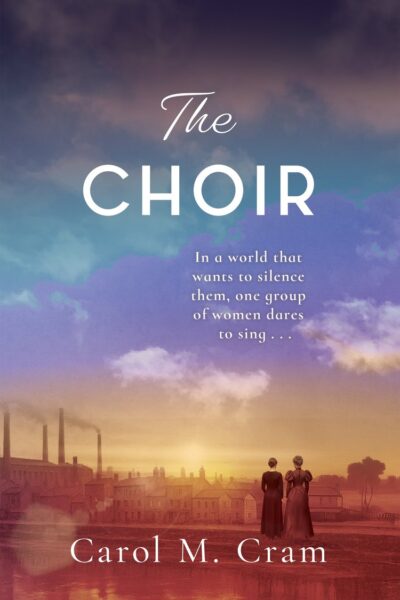
In a world that wants to silence them, one group of women dares to sing.
The Choir is a poignant, fascinating, page-turning tale. Carol Cram's prose is beautifully descriptive and her characters are compellingly rendered. This impeccably researched novel will take you on a heartfelt, sometimes painful, but ultimately uplifting journey that brims with emotion and joyous musicality. Highly recommended!" -- Syrie James, bestselling author of The Lost Memoirs of Jane Austen and The Secret Diaries of Charlotte Brontë
Set in 1890s Yorkshire, The Choir follows two women from working-class backgrounds whose lives have diverged dramatically. Eliza Kingwell is trapped in a difficult marriage in the mill town of Briarstown, scheming to win a choral competition prize as her ticket to freedom. Ruth Henton, her childhood friend, has become a celebrated London stage actress, until a single missed note begins to unravel everything she has built.
When a regional choral competition brings them back into each other's orbit, both women must confront old wounds, buried secrets, and the question of whether it is ever too late to reclaim the life they were meant to live. At its heart, The Choir is a story about resilience, reinvention, and what becomes possible when women refuse to remain silent.
You can purchase copies of 
Advance Praise for The Choir
"The Choir is a poignant, fascinating, page-turning tale. Carol Cram's prose is beautifully descriptive and her characters are compellingly rendered. This impeccably researched novel will take you on a heartfelt, sometimes painful, but ultimately uplifting journey that brims with emotion and joyous musicality. Highly recommended!" -- Syrie James, bestselling author of The Lost Memoirs of Jane Austen and The Secret Diaries of Charlotte Brontë
"A stirring exploration of how music can mend broken spirits and how women, when lifting each other up, create a harmony stronger than any single voice." -- Eliza Knight, USA Today bestselling author of Starring Adele Astaire
"Completely absorbing! We care so much about these two young Englishwomen struggling up from poverty and loveless lives by the power of friendship and music." -- Stephanie Cowell, author of The Man in the Stone Cottage, American Book Award recipient
"Bound by hardship and divided by loss, two former friends discover resilience and reconciliation through music. Rich with history and heart, and will remain with you like a favorite song." -- Herb Williams-Dalgart, author of Jingle Boys
"Two women wrestle with life's unexpected turns... a testament to female resilience, friendship, and the power of song." -- Judith Lindbergh, author of Akmaral
"An empowering story about reclaiming one's own voice." -- Nancy Burkhalter, author of The Education of Delhomme
What Readers are Saying
"The most moving and uplifting book I've read this year. I felt completely swept into the circle of brave, working-class women who discover their strength and dignity by learning to sing together." -- Jean Mader Booklover ★★★★★
"Music tells the story of two women born to sing. Beautifully written and ringing with authenticity, this compelling, compassionate story celebrates friendship, strength, courage, sisterhood, survival, and the healing, transcendent power of music." -- Helaine Mario ★★★★★
"Perfect for readers who love rich historical settings and unforgettable female resilience." -- Maryka Biaggio ★★★★★
"By the end of the story, I wanted to sing with those women in that choir." -- Zoe Disigny ★★★★★
Author Notes
The Choir began with a family mystery. When I was young, my grandmother spoke about relatives from "the first and second families." Her grandmother, my great-great-grandmother, had six children with one man, then left him and began a new life with another man and had seven more children. I kept asking: how did a working-class woman in a Yorkshire mill town, with no money and many children, manage to leave?
When I came across research on the mania for music competitions in late Victorian England, I found my answer and my story. Music offered Eliza a plausible and powerful path to transformation. A choir also gave me a beautiful metaphor: women finding collective strength, one voice at a time.
Eliza is inspired by my great-great-grandmother, who was born in a Yorkshire mill town and later ran a boarding house for many years. Writing this novel felt like coming closer to my own roots.
To research the world of the novel, I traveled to Yorkshire twice and visited preserved back-to-back workers' housing in Birmingham, where entire families lived, cooked, and slept in two or three cramped rooms across three narrow floors. I also visited a working cotton mill in Cheshire, where I heard the looms thunder to life. The noise was staggering. Imagining twelve-hour shifts in that din gave me a visceral understanding of what my characters endured every day.
I took singing lessons while writing the novel and sat in on choir rehearsals to understand what it feels like to listen as much as to sing, and to breathe in time with others.
History, I believe, should feel lived-in, not displayed.
Book Club Questions
Eliza and Ruth
- Eliza joins the choir for entirely practical reasons -- to win prize money -- not out of love of music. How does her motivation change over the course of the novel? At what point did you sense a shift?
- Ruth appears to have everything Eliza lacks: beauty, fame, freedom. Yet both women are, in different ways, silenced. How does the novel complicate the idea of what it means to have a voice?
- One reviewer described the novel as exploring how "talent alone is not enough -- opportunity, or the lack of it, shapes destiny." Do you agree? Where do you see this tension playing out in Eliza's and Ruth's stories?
- The two women share a history that has fractured over years of distance and silence. How does the novel handle forgiveness -- is it earned, given, or something more complicated?
Music and Community
- Choir membership required working-class women to listen as much as to sing, to breathe in time with others. How does this collective discipline affect the women in the novel? What does it demand of them that daily life does not?
- One reviewer said she finished the book wanting to sing with the women in the choir. Did you feel drawn into that community? What created that sense of belonging as a reader?
- The novel suggests that music can allow difficult emotions -- grief, anger, longing -- to surface safely. Do you think the choir functions as a kind of therapy for the women? Or is that too modern a reading?
- Music in the novel crosses class lines, appearing in mill towns and London theatres alike. What does the novel say about art as a democratizing force -- and what are its limits?
History and Place
- The industrial North of England is often portrayed in fiction as grim and culturally barren. How does The Choir challenge that image? Did it change or deepen how you think about working-class Victorian life?
- The constraints facing Eliza -- no independent income, no legal recourse, social stigma -- are specific to the 1890s. Yet several readers have described her situation as feeling deeply familiar. What, if anything, still resonates today?
- The novel is drawn partly from the author's own family history. Does knowing the inspiration change how you read Eliza's story? Does it matter whether the characters are "real"?
Resilience, Reinvention, and What Comes After
- The novel has been described as a story about "what becomes possible when women refuse to remain silent and compliant." What specific moments in the novel felt most like acts of refusal to you?
- Both Eliza and Ruth must reinvent themselves, but on very different terms. Whose reinvention did you find more difficult? More convincing?
- Healing in the novel is not about eliminating hardship but about finding the courage to move through it. Do you find that a satisfying or unsatisfying resolution? Does the ending feel earned?
- If you have ever sung in a choir, played in a band, or participated in any collective creative act, did reading this novel bring that experience back? What does the novel get right -- or miss -- about what it feels like to make something together?